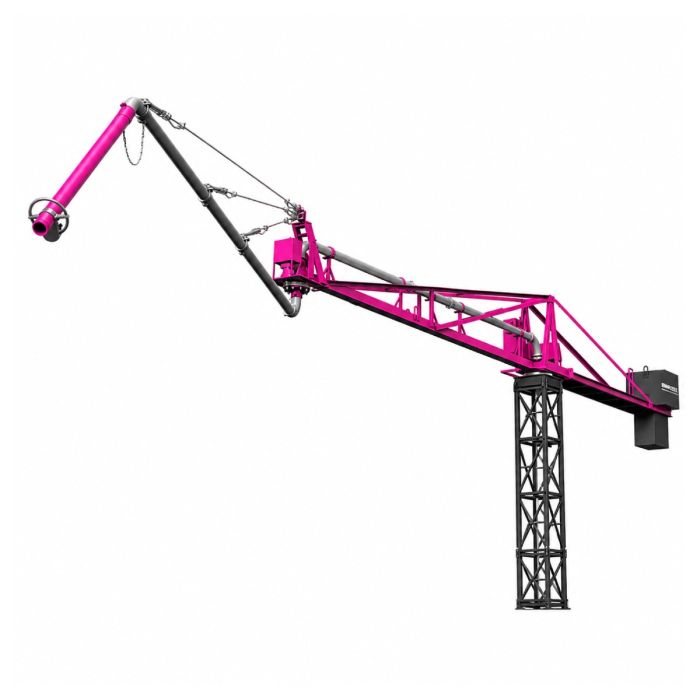
BMR Intelligent Follow-up Concrete Placing Pump
In stock
- BRAND:
- BMR
- ORIGIN:
- China
- Warranty:
- 12 MONTHS
- AVAILABILITY:
- SUBJECT TO AVAILABILITY
- SKU:
- BMR-Intelligent-Follow-up-Concrete-Placing-Pump
Intelligent Follow-up Concrete Placing Pump
Every concrete pour has a tug-of-war at its centre. The pump pushes the mix up the pipeline; a gang of workers hauls the discharge hose across the rebar mat, metre by brutal metre, steering a surging, concrete-filled line while the pour clock runs — the heaviest, most injury-prone choreography on the slab. The BMR Intelligent Follow-up Concrete Placing Pump retires the rope-pull by giving the pour a mechanical arm. A slewing hydraulic boom, offered in four models with placing radii of 12, 15, 18 and 20 metres, carries the concrete line above the deck and moves the discharge point by algorithm rather than by muscle: in follow-up mode, a single operator steers boom and arm from a joystick — cutting the placing crew to roughly 30 percent of traditional manpower — while in automatic mode the machine distributes the mix along preset paths with a uniformity human hauling never achieves, trimming the downstream leveling workload by around 13 percent and setting up the high-precision floors BMR's leveling and finishing robots then perfect. Remote and full manual modes complete a four-way switch that keeps concrete moving under any site condition, and the hardware is built for the vertical life: the larger HG18 and HG20 mount through preformed floor openings or ride the elevator shaft up the building as it rises, the compact HG12 and HG15 stand on outrigger spreads for slabs and basements, floor-transfer weights start at just 1.6 tonnes, and the whole family runs on 380-volt three-phase power in winds up to 13.8 metres per second.
The Intelligent Follow-up Concrete Placing Pump is available for purchase internationally through this page, with delivery, customs clearance and after-sales support arranged for buyers across Europe, the Americas, the Middle East, Asia-Pacific and worldwide.
Background
Where the pour actually hurts
Concrete placement concentrates the industry's hidden costs at the hose end. The dragging gang works the most hazardous square metres on site — unfinished decks, protruding rebar, live pipeline pressure — at the exact hours the batching schedule dictates, and their fatigue writes itself into the slab as uneven heaps that the leveling crew must redistribute. Placing booms solved the reach problem decades ago; BMR's contribution is solving the labour and uniformity problems on top of it. Algorithmic boom control converts placement from a team sport into a supervised operation, and preset-path distribution converts the mix from heaps into an even blanket — which is why the manufacturer's figures pair a roughly 28 percent placing-cost reduction with a measurable drop in leveling effort. In BMR's machine-sequenced concrete workflow, the placing pump is the first robot to touch the pour: what it lays down evenly, the leveling robot strikes faster, the finishing robot closes better, and the measuring robot certifies with fewer corrections.
Four models, two ways to stand
The family divides by radius and by mounting philosophy. The HG20 and HG18 are the tower players: 20- and 18-metre reach from bodies of 3.3 and 3.1 tonnes, installed through preformed floor holes of 1.2-by-1.2 to 1.5-by-1.5 metres or set inside elevator shafts of 2.1-by-2.1 to 2.3-by-2.3 metres, climbing the structure level by level as the frame rises — with minimum floor-transfer weights of 2.5 and 2.2 tonnes keeping crane cycles short. The HG15 and HG12 are the floor players: 15- and 12-metre reach on freestanding outrigger spans of 4.2-by-4.2 and 3.6-by-3.6 metres, at 1.7 and 1.6 tonnes, sized for basements, podium slabs and mid-scale pours where mobility between zones matters more than tower reach. Shenzhen BrightMaster Robotics — global exclusive agent of the Bozhilin construction-robot portfolio and a full-stack developer in its own right — backs the family with references from the Foshan Fengtong Garden residential development to the CanSino Asia-Pacific headquarters pour in Guangzhou.
Technical Specifications
| Parameter | HG12 | HG15 | HG18 | HG20 |
|---|---|---|---|---|
| Max. placing radius | 12 m | 15 m | 18 m | 20 m |
| Total weight (excl. counterweight) | 1.6 t | 1.7 t | 3.1 t | 3.3 t |
| Min. weight for floor transfer | 1.6 (2.2) t | 1.7 (2.2) t | 2.2 t | 2.5 t |
| Installation | outrigger span 3.6 × 3.6 m | outrigger span 4.2 × 4.2 m | preformed hole 1.2×1.2–1.5×1.5 m or elevator shaft 2.1×2.1–2.3×2.3 m | preformed hole 1.2×1.2–1.5×1.5 m or elevator shaft 2.1×2.1–2.3×2.3 m |
| Operating voltage | AC 380 V (±40 V), three-phase five-wire | |||
| Control modes | automatic (preset-path placing) / follow-up (single-person joystick) / remote / manual | |||
| Max. wind resistance | 13.8 m/s (force 6) | |||
| Manpower | placing completed with ~30% of traditional crew (follow-up mode) | |||
| Placement quality | automatic-mode uniformity reduces leveling workload by ~13% | |||
| Economics | ~28% placing-cost reduction; ~3× durability (per manufacturer) |
Boom configurations, counterweights and pipeline accessories are confirmed at quotation.
What does "follow-up" actually change on pour day?
The headcount and the heap. In a conventional pour, placement quality is a function of how many people can wrestle the hose and how fresh they still are — so contractors staff for the worst hour and accept the unevenness of the last one. The follow-up system replaces that arithmetic: one operator's joystick commands become coordinated boom-and-arm motion, the discharge point glides where it is pointed, and the same placement precision holds from the first cubic metre to the four-hundredth. Switch to automatic and the machine goes further — sweeping preset paths that lay the mix as an even layer instead of a chain of piles, which is where the 13 percent leveling saving comes from: concrete placed level is concrete that barely needs moving. The remaining two modes are insurance written into the control system: remote operation when the operator should stand elsewhere, and traditional manual pulling as the fallback that guarantees no pour ever stalls on electronics. The result reads on three ledgers at once — roughly 70 percent of placing labour redeployed, the slab's flattest starting condition, and a hazard zone with almost nobody left standing in it.
Who is the Intelligent Follow-up Concrete Placing Pump for?
For high-rise structural contractors pouring floor after identical floor, where the HG18 and HG20's shaft-and-hole mounting turns placement into a climbing installation that rises with the core; for basement, podium and industrial-slab contractors, where the outrigger-based HG12 and HG15 move zone to zone across large flat pours; for concrete specialists already running — or adopting — BMR's leveling, finishing, screeding and measuring robots, for whom the placing pump completes the machine-sequenced pour from pipeline to certified slab; for developers and general contractors targeting placing-labour costs and hose-gang safety exposure directly; and for markets where pour-night crews are the scarcest resource on the schedule. Model choice follows the building: radius sets coverage per setup, mounting type matches structure, and transfer weight matches the site's crane capacity.
What is the Intelligent Follow-up Concrete Placing Pump used for?
- High-rise floor placement: shaft- or hole-mounted booms distributing concrete level by level as the tower rises.
- Basement and podium pours: outrigger-mounted placing across large flat slabs and underground structures.
- Automated distribution: preset-path placing that lays uniform layers for high-precision floors.
- Single-operator placing: joystick follow-up control replacing the traditional hose-dragging crew.
- Residential and commercial slabs: scheduled pours completed with a fraction of conventional manpower.
- Robot-sequenced concrete workflows: feeding BMR's leveling, finishing and measuring robots an even pour to process.
Pricing and Availability
The Intelligent Follow-up Concrete Placing Pump is available for purchase and international delivery through this page across its HG12, HG15, HG18 and HG20 models — as single units, in multi-boom packages for large decks, or within coordinated BMR concrete-robot schemes alongside the leveling, finishing, screeding and measuring machines. Price and cost depend on model, mounting configuration, counterweight and pipeline provisioning, training and commissioning scope, and quantity, so buyers should request a current quotation for their structure and pour profile; delivery, customs clearance and after-sales support are arranged worldwide. Purchase enquiries, datasheets and availability details for the Intelligent Follow-up Concrete Placing Pump are available on this page.
Frequently Asked Questions
What is the Intelligent Follow-up Concrete Placing Pump?
An automated concrete placing boom family from BrightMaster Robotics — four models with 12- to 20-metre placing radii — that distributes pumped concrete across floors, high-rise levels and basements under algorithmic boom control, replacing the traditional hose-dragging crew.
How much labour does it save?
In follow-up mode, a single joystick operator completes placing work that conventionally takes a full crew — roughly 30 percent of traditional manpower — with the manufacturer citing around a 28 percent reduction in placing costs overall.
What is automatic mode?
Preset-path placement: the boom sweeps programmed routes and lays the mix as a uniform layer rather than a chain of heaps, reducing the downstream leveling workload by about 13 percent and giving high-precision floors their best starting surface.
How is it installed on a high-rise?
The HG18 and HG20 mount through preformed floor openings of 1.2-by-1.2 to 1.5-by-1.5 metres or stand inside elevator shafts of 2.1-by-2.1 to 2.3-by-2.3 metres, transferring upward floor by floor at minimum lift weights of 2.2 to 2.5 tonnes as the structure climbs.
Which models work without floor openings?
The HG12 and HG15: freestanding units on outrigger spans of 3.6-by-3.6 and 4.2-by-4.2 metres at 1.6 and 1.7 tonnes — suited to basements, podium slabs and open floor plates, with 12- and 15-metre reach.
What happens if conditions turn against automation?
The four-mode switch is the answer: automatic, follow-up joystick, remote and traditional manual operation are all built in, so placement continues on schedule in any circumstance, in winds up to 13.8 metres per second.
Where can I buy the Intelligent Follow-up Concrete Placing Pump and what does it cost?
The placing pump is available through this page, with delivery, customs clearance and after-sales support arranged for buyers worldwide. Because cost varies with model, mounting configuration and quantity, buyers should request an individual quotation. All purchasing details are available on this page.
Summary
The Intelligent Follow-up Concrete Placing Pump takes the pour's hardest job — hauling a live concrete hose across a rebar deck — and hands it to an arm that never tires: 12 to 20 metres of algorithm-steered reach, one operator where a gang used to strain, and an automatic mode that lays the mix so evenly the leveling that follows shrinks by an eighth. Climbing shafts on the towers, standing on outriggers in the basements, and switching through four control modes so no pour ever waits, it opens BMR's machine-sequenced concrete line at the source — placing evenly what the leveling, finishing and measuring robots then carry to a certified floor. For contractors done staffing tug-of-wars, this page is the starting point.